Paint Correction Explained: What Those Swirl Marks Actually Are
You've probably noticed them — those fine, circular scratches that appear on your car's paint when sunlight hits at the right angle. They look like spider webs radiating across your bonnet, doors, and boot lid. These are swirl marks, and they're one of the most common forms of paint damage on modern vehicles. But what exactly are they, and why does professional correction matter?
Understanding Your Vehicle's Paint System
Modern automotive paint consists of multiple layers, each serving a specific purpose. From the metal body panel outward, you have:
Primer — the foundation layer that promotes adhesion and provides corrosion protection. This layer is typically 15-25 microns thick.
Base coat — the colour layer. Whether your car is black, white, red, or metallic silver, this is where the pigment lives. Base coat is usually 15-30 microns thick.
Clear coat — the transparent protective layer on top. This is the layer you actually see and touch. Clear coat is typically 40-60 microns thick on factory paint, and it's this layer that suffers from swirl marks, scratches, and oxidation.
To put those numbers in perspective, a human hair is approximately 70 microns thick. Your clear coat — the layer protecting your vehicle's appearance — is thinner than a single strand of hair.
What Causes Swirl Marks?
Swirl marks are micro-scratches in the clear coat, typically 2-5 microns deep. They appear circular because they follow the rotational pattern of whatever caused them. The most common causes include:
Improper washing techniques — this is the number one cause. Using a single bucket, dirty wash mitts, or circular wiping motions drags contaminants across the paint surface, creating thousands of fine scratches. Drive-through car washes with their spinning brushes are particularly destructive.
Automated car washes — the brushes in automatic car washes accumulate grit and debris from every vehicle they touch. Each pass of these contaminated brushes creates new scratches in your clear coat.
Drying with improper materials — using old towels, chamois leather, or any material that isn't specifically designed for automotive paint can cause scratching during the drying process.
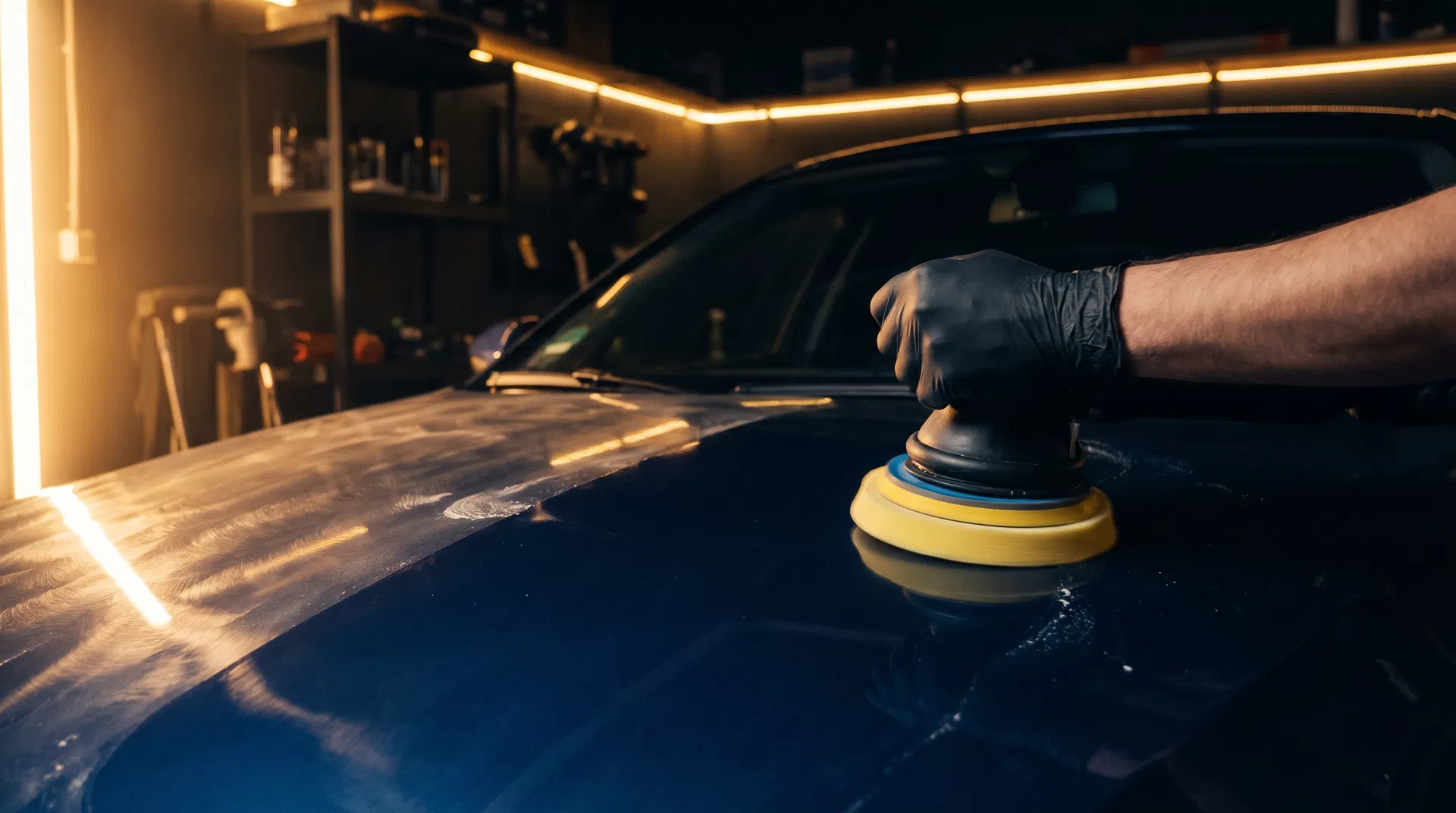
Poor polishing technique — ironically, attempting to remove swirl marks with incorrect products or technique can create more damage. Random orbital polishers in untrained hands can cause holograms — a distinctive pattern of marks that's even more visible than the original swirls.
The Difference Between Correction and Filling
This is a critical distinction that many vehicle owners don't understand. There are two fundamentally different approaches to dealing with swirl marks:
Paint correction (what CommandaPro does) involves carefully removing a controlled amount of clear coat to level the surface below the depth of the scratches. Using professional-grade compounds and dual-action or rotary polishers, we literally cut away the damaged layer to reveal the undamaged clear coat beneath. The result is permanent — those scratches are gone, not hidden.
Filling (what most quick-detail products do) involves applying a product that fills the scratches with temporary material — wax, silicone, or polymer fillers. The scratches appear to vanish, but they're still there. As soon as the filler washes away or degrades, the swirl marks return. This is what happens when you apply an "all-in-one" polish from the auto store.
Why Professional Correction Matters
Paint correction is not a DIY-friendly process. Here's why:
Paint thickness measurement — before any correction work begins, a professional detailer uses a paint thickness gauge to measure the clear coat depth across every panel. This tells us exactly how much material we have to work with and ensures we never cut through the clear coat.
Compound and pad selection — different paint types (hard Japanese clear coats vs. soft European clear coats) require different combinations of cutting compounds and polishing pads. Using the wrong combination can cause more damage or fail to correct the existing damage.
Machine technique — professional paint correction requires controlled speed, pressure, and pattern. Too much pressure or speed generates heat that can burn through clear coat. Too little and the compound won't cut effectively.
Lighting — professional detailers use specialised inspection lights (LED panels and swirl-finder torches) to identify defects that are invisible under normal lighting. Without proper inspection lighting, you can't see what you're correcting.
The CommandaPro Process
When you book a Cut & Polish with CommandaPro, here's what happens:
1. Full decontamination wash — removing all surface contaminants before any machine touches the paint 2. Clay bar treatment — removing embedded contaminants that washing can't reach 3. Paint thickness measurement — recording readings across every panel 4. Defect assessment — using inspection lighting to map all scratches, swirls, and defects 5. Test spot — correcting a small area to determine the optimal compound and pad combination 6. Multi-stage correction — working through progressively finer compounds to remove defects and refine the finish 7. Final inspection — checking every panel under multiple light sources 8. Protection — applying sealant or ceramic coating to protect the corrected surface
The result is paint that looks better than the day it left the factory. Deep, liquid gloss with zero swirl marks, zero holograms, and a mirror-like reflection that turns heads.